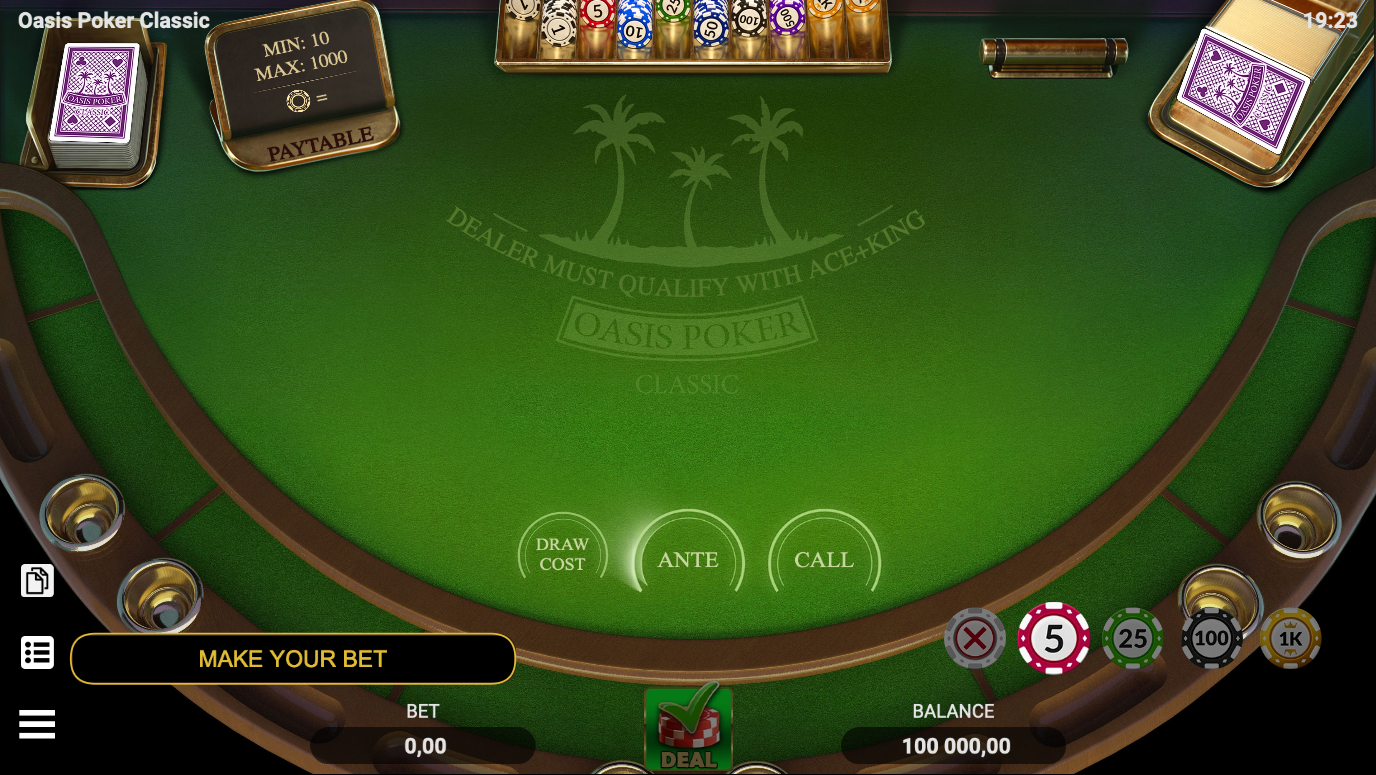
Oasis Poker is Caribbean Stud with one addition: you may pay to exchange cards before deciding. The fee is priced above what the swap is worth, which makes every exchange a slightly bad bet taken voluntarily.
How a hand runs
Ante, five cards, one dealer card face up. Before choosing to raise or fold you can buy replacements — typically the ante for one card, rising steeply beyond that. Then the usual rule applies: the dealer needs ace-king or better to qualify, and if they do not, the ante pays and the raise is returned.
The exchange fee is not returned. That detail is where this variant earns its keep.
When the exchange is defensible
Narrowly. One card from a flush or a straight, with the dealer showing a card that makes qualification likely — those are the cases where the improvement is worth roughly what it costs.
The classic mistake is breaking a low pair to chase something better. A pair already beats a non-qualifying dealer, and non-qualification is common. Swapping away a made hand to buy a maybe is how this game separates people from money.
The rest of the strategy
Raise on any pair or better; fold below ace-king. The band between is where the fine detail lives and it depends on the dealer’s up card. Playing correctly narrows the house edge and never crosses it — the ante is paid on every hand, including all the ones where the dealer never plays.
Is it rigged?
The deal and the replacements come from the same tested generator; the exchange does not draw from a separate deck. Independent laboratories certify it before Evoplay can supply an operator.
Certification covers the cards, not the casino — our comparison ranks houses by licence in public registers and by unresolved complaints.
Practise it free
Forty hands refusing every exchange, then forty taking them freely. The gap in the balance is the fee doing its work, and it argues better than this page can.

 Español
 Português de Brasil
 Hrvatski
 Deutsch
 Italiano
 Français
 Čeština
 Polski
 Lietuviškai
 Svenska
 Română
 Norsk Nynorsk
 Русский
 Українська
USER EXPERIENCE RATING